

GROUND INVESTIGATION
Know the ground before you build
Uncertainty about ground conditions can lead to unforeseen hazards, delays and additional construction costs. An appropriate ground investigation at the outset gives the design team better information and can help avoid expensive surprises later.
Alongside Phase II environmental investigation, we provide ground information needed to inform foundation design. Our techniques include trial pitting, cable percussion boreholes, dynamic sampling, dynamic probing, plate load tests, cone penetration testing and geophysics.
Investigations are designed with reference to relevant guidance, including the ICE guidance for drilling landfills and contaminated land, Eurocode 7 and appropriate British Standards. Ground investigation staff have relevant geological or civil engineering qualifications and experience, and hold CSCS cards. Drilling rigs are operated by qualified drillers with land drilling NVQs, CSCS certification and first-aid training.
INVESTIGATION METHODS
Drilling and boring options
We offer dynamic sampling and cable percussion boring in drift soils, together with rotary open-hole and cored drilling in bedrock. Where required, boreholes can include gas or groundwater monitoring wells and piezometers.
Choose a method below to read how it works, the samples and tests it supports, and its practical limitations.
CABLE PERCUSSION
Cable percussion boring
Cable percussion drilling advances a borehole by repeatedly lifting and dropping tools to cut into the ground or remove material. It is commonly used for geotechnical and environmental investigations in superficial deposits rather than bedrock.
The rig is usually an A-frame towed by a four-wheel-drive vehicle, although some are lorry-mounted and may also offer rotary drilling. A winch cable passes over a pulley at the top of the mast to steel boring tools, typically around 1,500 mm long and 140–300 mm in diameter.
Tools and borehole support
Material enters the open end of the tool as it strikes the ground and is recovered when the tool is withdrawn. Water may be added to assist. A shell with a flap valve is used in non-cohesive ground, while a claycutter with side windows is used in cohesive soils. A chisel can break through cobbles or boulders before boring resumes.
Casing supports the borehole and helps control unwanted groundwater entry. Several casing strings may be needed where different formations must be sealed off. Conventional diameters are 250 mm, 200 mm and 150 mm, with 150 mm commonly used.
Where drilling passes through a confining layer into an aquifer, staged casing and a robust bentonite seal may be used at each reduction in diameter. The seal is allowed to hydrate before drilling continues at the smaller diameter.
Samples, testing and access
Disturbed bulk samples can be taken from drill cuttings. Undisturbed samples can be recovered using U38 or U100 tubes; U100 is also known as U4. In-situ tests such as Standard Penetration Tests (SPTs) can be carried out during drilling.
Cable percussion is generally used at depths below 40 m, with contamination investigations commonly extending 5–20 m. Heavy-duty rigs can reach greater depths. The approximately 6 m A-frame can restrict access, although reduced-mast rigs are available for limited headroom. The method can generate substantial spoil and mess, particularly in soft clays, sands and silts.
ROTARY BORING
Rotary boring
Rotary techniques are used in very dense gravel or bedrock, including investigations of shallow mine workings and rock quality. Cored drilling recovers rock in seamless plastic liners for engineering logging and laboratory testing.
Rotary coring can recover samples at a range of diameters. Experienced geoenvironmental engineers log the cores with reference to relevant British and European Standards.
Rotary open-hole drilling returns rock cuttings to the surface rather than recovering a continuous core. It allows rapid examination of the strata and can be useful for locating shallow coal seams or mine workings and completing several boreholes efficiently.
Gases including carbon monoxide, methane and carbon dioxide can be monitored continuously while drilling through old mine workings.
DYNAMIC SAMPLING
Dynamic sampling and probing
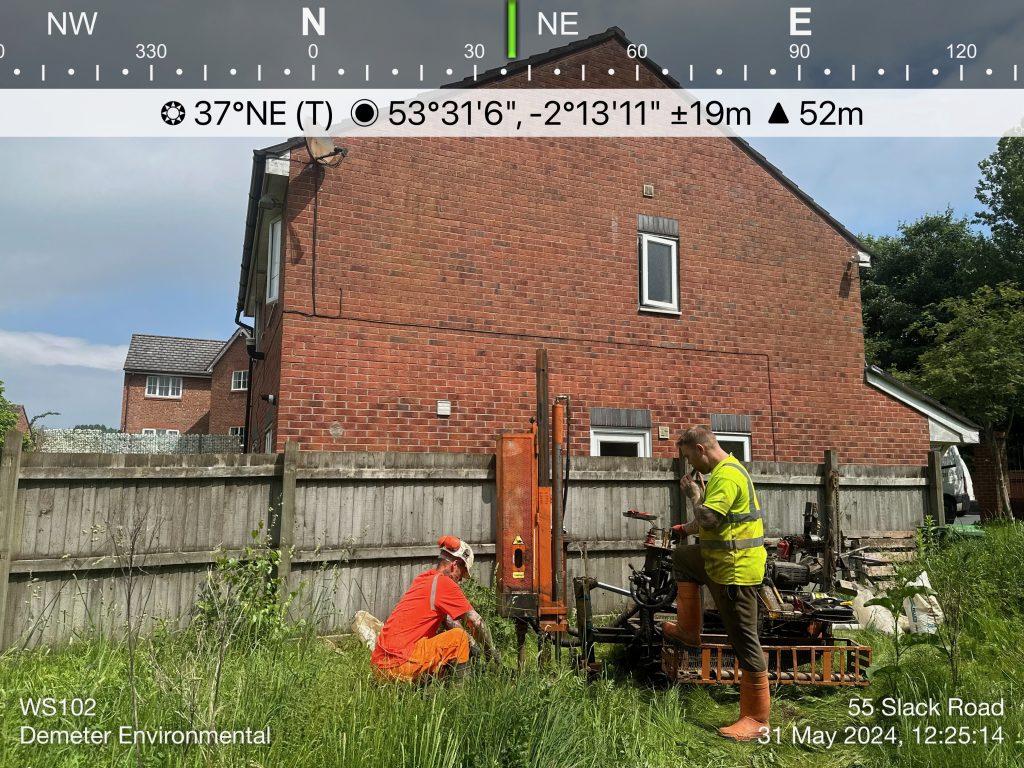
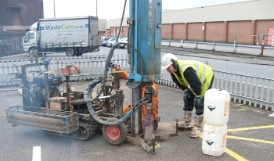
Window sampling is a percussive method for forming small-diameter boreholes. It can use hand-held equipment or a small rig, with rig power allowing sampling and recovery from greater depths.
The sampler is a high-tensile steel tube with a hardened cutting shoe and windows or slots through which the soil can be examined and removed. Samplers are commonly 1 m or 2 m long and are driven using a percussion hammer. A set typically reduces from around 80 mm to 35 mm in diameter as depth increases.
Depth and sample recovery
The technique is usually used to around 5 m, although depths of 8–10 m may be possible. Recovery can be the limiting factor: dense, coarse gravel may grip the sampler and make extraction difficult. The driller assesses conditions at each location.
Starting diameter depends on the ground; softer soils allow wider samplers. A typical start is 60–80 mm, reducing to around 35 mm at 4–5 m. Full samplers are removed using manual or hydraulic jacks.
The recovered soil shows a full or partial profile, but compression must be considered when interpreting it. Some systems recover samples in thin transparent liners that can be inspected or capped for transport to the laboratory.
Sample volume is limited. Where extensive analysis is needed, a sample may need to cover around 0.5 m of ground to provide enough material. Little excess soil normally remains after sampling and backfilling.
Monitoring installations and limitations
Narrow gas or groundwater installations can be placed after the samplers are removed. The lowest sampler diameter controls the installation size; 19 mm or 35 mm standpipes with a fine gravel surround are commonly possible. Some systems can drive a water well through unsampled ground.
This method is unsuitable for drilling through a confining layer into an aquifer where the aquifer cannot be protected from downward migration of contaminants during drilling.
Restricted access and minimal disturbance
Equipment is brought to site in a van or four-wheel-drive vehicle and can then be carried around the site by hand. This can provide access where even small rigs cannot operate.
Window sampling causes limited surface disturbance and can be useful inside buildings, in landscaped parking areas, between railway sleepers, on small operational sites and in gardens. It can also provide rapid shallow coverage, for example when checking the thickness of a landfill cap.
ELECTRIC SAMPLING
Electric dynamic sampling
We also offer an electrically powered unit for windowless sampling and SPTs. An electric power pack replaces the petrol or diesel power source and runs the rig hydraulics from a suitable 13-amp socket or generator.
The electric unit produces no local engine exhaust fumes, making it useful inside buildings, in restricted areas and on petrochemical sites where suitable. An electrically powered hand-held sampling unit is also available for restricted access or headroom.
LET’S TALK ABOUT YOUR SITE
Your next project starts here.
Tell us about your site and the services you need. These details help our team understand your requirements and respond with relevant advice.
For the reason for your enquiry, you might mention a contaminated land planning condition, a pre-purchase assessment, geotechnical requirements or soil infiltration testing.
Prefer to speak to us?
0151 521 2539
Tell us what you need
Complete all fields except the optional planning reference. Select every service that applies.